The Challenge
Multi-SKU D2C catalogue with strong organic discovery on Amazon. Risk: existing customers kept buying through brand search — ad spend was mostly farming retention, not building new-customer acquisition. Brand needed audience expansion without breaking the unit economics.
Why the name is withheld
Client has not authorised public reference. Numbers below come directly from the live Amazon Ads account.
What we did
1. Reduced brand-defence farming
Brand-term campaigns were running at high spend, converting customers who would have searched the brand anyway. Cut Defence spend by ~40%, redeployed budget into Discovery (category-broad keywords).
2. Adjacent-category keyword expansion
The team mapped SKUs to adjacent search categories — buyers searching one query might also need the brand’s other SKUs. Bidding on adjacent-but-not-overlapping queries expanded reach into customer segments that hadn’t seen the brand.
3. SKU-cluster bid management
Catalog grouped into 4 lifecycle clusters (Launch / Growth / Mature / Decline). Each cluster had its own ACOS target. ScaleSkus applied the right rule to the right cluster automatically.
Result
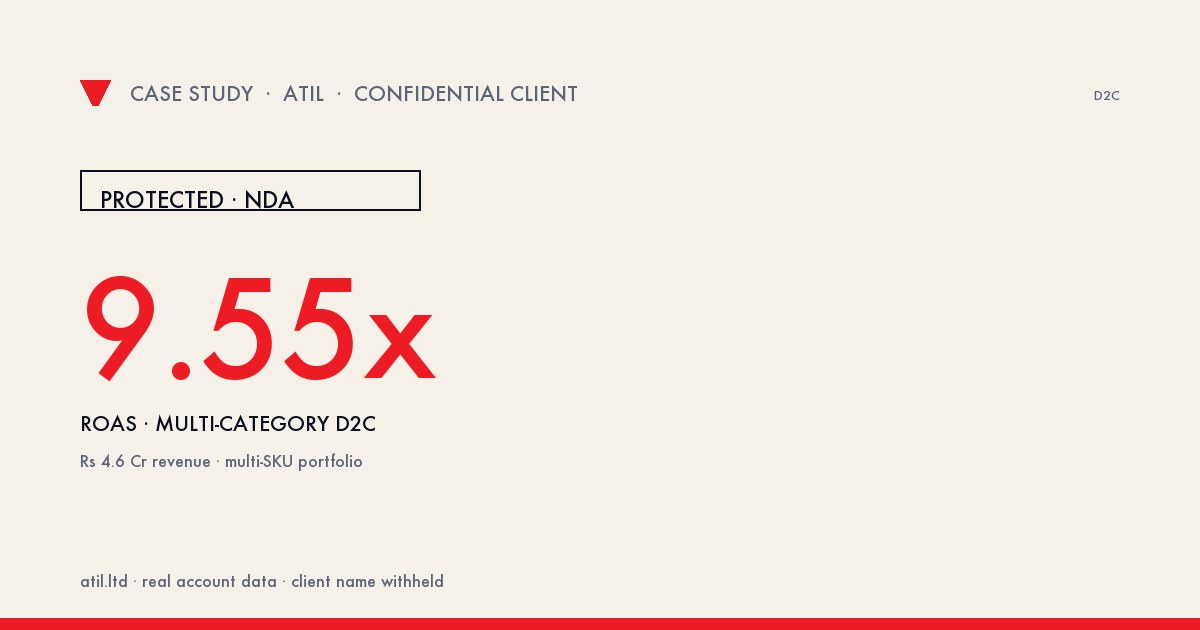
- Blended ROAS: 9.55× — one of the strongest in our portfolio
- Total Amazon revenue: ₹4.60 Cr
- Ad-attributed sales: ₹0.86 Cr (only 19% of total)
- Halo ratio: 4.35× — the ad spend mostly built awareness; conversions came organically
This is what efficient D2C scaling looks like — small ad budget, disproportionate Amazon revenue compounding.
Free Amazon audit — we’ll run the same diagnostic on your account.
Result
9.55× blended ROAS sustained across full window. ₹0.86 Cr ad-attributed sales + ₹4.60 Cr total Amazon revenue. Halo ratio 4.35× — every ₹1 of ad spend drove an additional ₹4.35 in organic Amazon sales.
9.55×
Blended ROAS
₹4.60 Cr
Total Amazon Revenue
₹0.86 Cr
Ad-Attributed Sales
4.35×
Halo Ratio
Under NDA
Client Name
Live ad account
Data Source